DE/SEMBLE (9/10 October)
I got press tickets for these two nights.
9 October: DoYeon Kim + Omid Darvish hosting Rojin Sharafi, Thomas Wagensommerer, and Jorge Sánchez-Chiong
For me, DE/SEMBLE 2026 started off on a high and loud note, with DoYeon Kim belting in Korean from behind the audience and slowly stepping into position to play the gayageum (a Korean zither-like instrument). This immediately got me out of my comfort zone, in a good way: from now on I was conditioned for loud and intense music. I don’t know how the gayageum is traditionally played, but I dare say that what we witnessed partially went beyond “extended technique”: extremely fast plucking, drone-like bowing, stretching strings so much so that they would touch the instrument’s body and create sharp snapping sounds. While there were also beautiful quieter moments, even these were charged with tension. Most of the time, however, Kim’s playing was immensly energetic. As she told us in a short break, she had been singing/saying to us: “Let’s fucking rock’n’roll! Let’s dance!” After this break, Kim performed what I considered a drum solo on the gayageum ending in a “destruction” of the instrument: most of the bridges supporting the strings had fallen over. To me, the entire performance had no filler parts, everything felt urgent and full of expression. What I was unsure about, however, was the amplification of the instrument. It seemed to me that the natural ambience of the gayageum was completely drowned out, which never really stopped to irritate me, though I’m not sure there would have been any way of doing Kim’s performance without amplification.
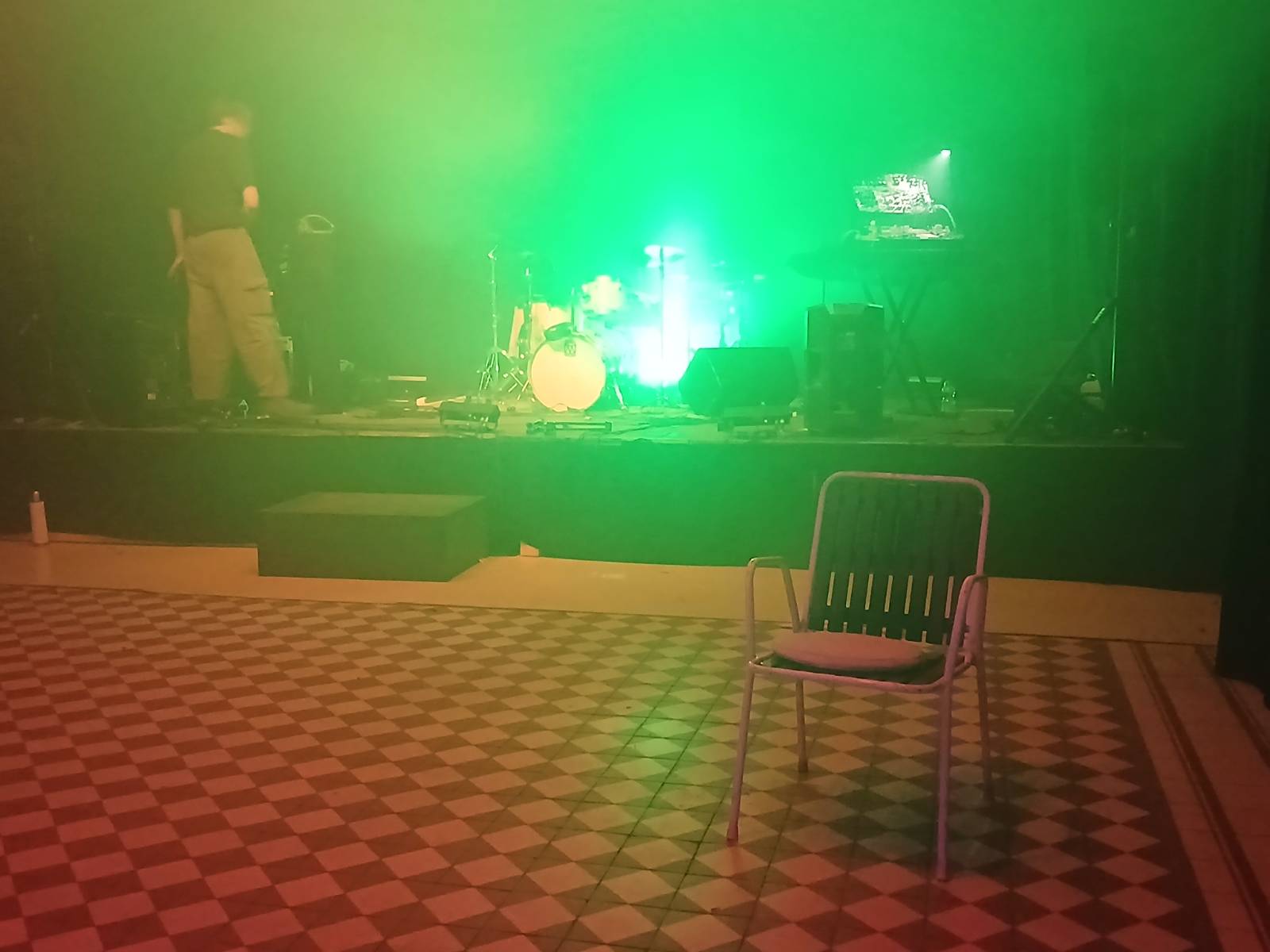
The second and last performance, a live electronic session by Omid Darvish, Rojin Sharafi, Thomas Wagensommerer, and Jorge Sánchez-Chiong, started off with cosmic epic synths by Sharafi and lamenting vocals by Darvish which set the tone for a more nuanced (and less maximalist) experience than I had somehow expected. It took a while until all four performers joined the session, in which there was room for everyone with their own signatures (including what sounded like murmuring and gurgling by Wagensommerer and some really deconstructed beats by Sánchez-Chiong), even though there were clear leads. Personally, I enjoyed the parts most when beats were propelling everything forward, and especially the moment that I considered the climax when everyone was going all out and the volume reached new heights. Which brings me to the venue. Generally I like it when festivals use venues that are not your average and well-known music space, and on that general level, I appreciated that on Friday, DE/SEMBLE was happening at the DAS Margareten theatre I had never been to before. But unfortunately for this event, I think it was not an ideal choice. DoYeon Kim’s performance was at times so energetic and percussive that dancing (or at least head-shaking) would have been appropriate – we even received an invitation by her to move –, but with seats in ascending rows, the physical threshold was simply too big. Similarly, the electronic group performance reached (breakbeat!) heights that really warranted movement. In general I felt that less distance between the audience and the artists and more freedom of movement would have made this evening of great music a better experience.
10 October: Cleo Reed + Juli Deak & Lorenz Widauer + other:M:other + Hermeneia
Many people who were in the audience will agree that Cleo Reed’s performance together with Matthew Jamal on strings was one of the best and most beautiful music shows of the year. Last year, Cleo Reed released “Cuntry”, an album that has often been called “electronic-folk” but (at least) also extends into rap and r’n’b. It talks about labour, being queer, being Black, it’s personal and it’s political, it’s extremely diverse and it sounds great. One of my favourite albums ever. So I was already super excited coming to Kollektiv Kaorle, where DE/SEMBLE was happening that day. And I was not disappointed in the least. a) Cleo Reed has amazing stage presence b) this was way more than just a live version of an album (Cleo’s voice during quiet parts! Like them singing the song “I Been Out Here Hustlin’” without any accompaniment at the beginning, which made me think of soloistic “The Star-Spangled Banner” performances before the start of sports matches, just like, actually good and beautiful. But also the moments when we were hit by some body-shattering bass!) c) it was a communal experience (with non-awkward(!) audience singing) that captured everyone (from what I could tell going completely crazy in the first row). After this I was in a rare music-induced high and therefore in the perfect mood for the short spontaneous “intervention” by Juli Deák (flute), who was originally only supposed to perform her solo show at Reaktor the next day, and Lorenz Widauer (trumpet). Starting from the balcony, they started luring us back inside to the next concert with magical flute melodies supported by a (muted, I think? I didn’t manage to ask Widauer) trumpet accompaniment. This could have been extremely silly, but it worked perfectly. Kudos at this point to the organisers for having artists play multiple times in different contexts throughout the festival (DoYeon Kim performed again on Sunday together with Lukas Lauermann). It made the multi-day event feel like a big whole.
The “intervention” was followed by quite a stylistic switch to a pattern-heavy, percussion-forward performance by modular synthesizer, prepared piano, and extended drumset trio other:M:other, which in a certain sense was definitely headier than the previous shows but did not fail to make me move erratically. In a way that made me think of the unforgettable Wetter etc. performance at Westbahnstudios earlier this year, they seamlessly built up from slower, more quiet and transparent parts to louder, more frenetic and complex parts, and, perhaps even more magically, also managed to let everything fade out just as skilfully. To finish everything off, Hermeneia played a really organic low-end wavey set of a rather rare sort for my nightlife experience of Vienna. Unfortunately, however, the crowd was not there for it (literally, as in a lot of people had left right after other:M:other) and even those who stayed could not be motivated to dance. This is where the festival’s booking concept for the night – diverse acts to keep things interesting –, which I personally very much appreciated, sadly failed. Kollektiv Kaorle, however, was a great choice of venue for very focused concert experiences, with everyone having made their way to OWA with the mission of listening to good music. Not least, it also has great sound and a really comfortable (dance)floor that allows for any kind of audience response. But it was the music first and foremost that made Saturday definitely one of the most unforgettable nights I’ve had in Vienna so far (shout-out also to all the cute people I talked to throughout the evening!). Already looking forward to next year’s DE/SEMBLE!## Review: DE/SEMBLE (9/10 October)