Unsafe+Sounds Festival 2026
(again, disclaimer: we got two press tickets for this)
Okay, so we had a good chat about our experiences of this year’s festival and want to start off by stating the obvious and maybe most important, namely that there was a lot of fantastic and beautiful and very good music. For anyone who hasn’t been before, Unsafe+Sounds is more or less Struma & Iodine: The festival, both in terms of represented music styles as well as in who is behind it. As such, it provides a yearly fixture for experimental music scenes in Vienna and an impressively tapped-in showcase of current cutting edge music (mostly from but not at all limited to Europe-based artists). In the words of one of us: “Leute die das ganze Jahr geile Scheisse machen kommen zusammen und machen fett geile Scheisse”. All of that without the institutional or monetary backing of, let’s say, Donaufestival (Mikl-Leitner says hi). While we don’t wish the grip of institutions on U+S, some more resources would certainly make difficult things easier (we don’t want to lose our OGs to burn out) and cool - or warm? - things possible (we noticed a predominance of solo shows, though this doesn’t have to be connected).
Speaking of temperature (hehe), this year’s edition had the beautifully sonorous theme “The level sunlight still warms walls”, announced together with a befitting turn towards Romanticism and, thereby, nature, sentiment, and the sensual. A radical positioning like this - radical for when and where we are now - would have certainly also profited from more discourse opportunities about the possibilities and limits of the aesthetics (making use of irony, privileging the fragmentary) and politics (navigating revolution and escape, putting subjective human experience first) of the Romantic in this particular day and age. But considering the realities of doing a left-field festival like this under current conditions (from what we can gather), we can assume that this was not due to a lack of ideas.
In terms of the music, this year’s theme actually felt like a pretty appropriate expression of the booking choices. While there was a number of more intense and/or confrontational highlights (Saint Abdullah & Eomac, Azzi on the Beat, some would also say Earth Ball), many of the shows that stayed with us most, like Ugnė Uma, feeo, Youmna Saba, Fennesz & Claire M. Singer, Bara & Isa, … were of a gentler, warmer, softer power. Not to mention the opening night, which was the sickest one we have experienced at U+S so far (see below) and where the level sunlight literally warmed walls.
We enjoyed the range of venues as a whole (AIL, Porgy, RKH, WUK, Flucc). The mingling of crowds might not always have been frictionless, but the festival always made sure its people were in a good place and it was well worth to see the festival come to live in these different spaces, some of which we oterhwise rarely frequent (one of them with an organ, no less!). Not least, we were also delighted by compelling photography from the precipice between nature and culture by Philipp Gerlach, snippets of poetry full with lust for the world, and, particularly fitting this year, details like the traditional flower bouquets that welcomed us on every festival day(!). But now on to our individual (hardly edited for conformity lol) impressions of the concerts.
4 September
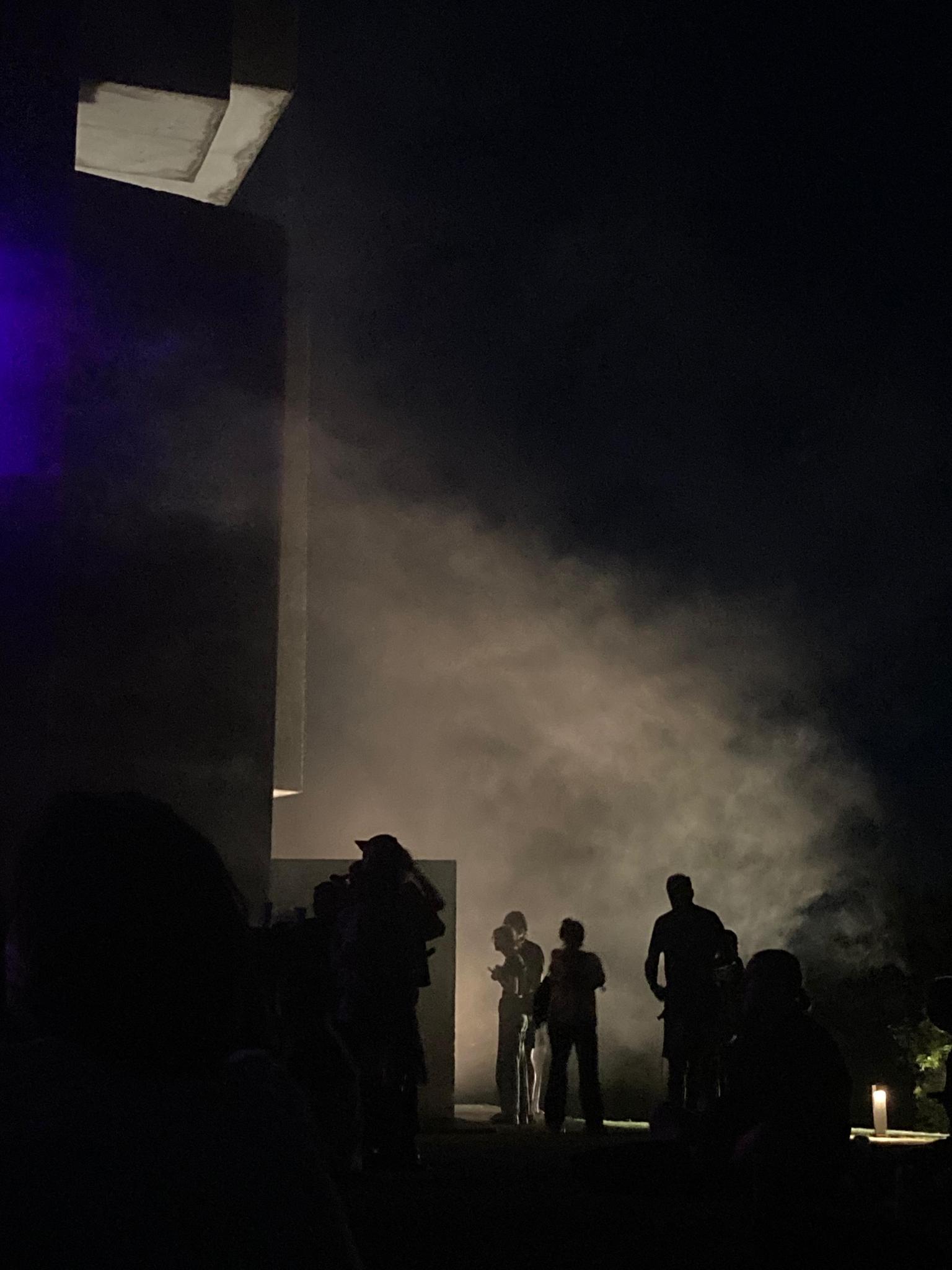
After a longer-than-usual journey and a bit of uphill walking, I arrived at Wotrubakirche which, for those who have never been there, is an impressive and unique sight for sure. People were gathered around the soundsystem outside which was playing a great selection of atmospheric sounds but the first performance was yet to start.
First up, Robert Schwarz performed his insect-themed Stridulations 1-14 project. Having seen this set being performed multiple times by now, I must say that this occasion was my favorite one so far. The outside setting and the sight of Robert Schwarz sitting in front of a brutalist church surrounded by swaths of fog (evoking feelings of alien technology) matched the music very well. I was looking at an ant up close which had crawled onto my arm while the PA was emanating complex computer music and stridulating cicada rhythms - a great and heady way to start the festival day.
We continued inside, where Tony Wagner presented the newly comissioned Clustertract / Luxxx piece on violin and effects. The intense and emotional drones had a great effect on the Sounds Better With You soundsystem inside of this big concrete structure. Closing my eyes really made me immerse deeply into undulating layers of beating violin frequencies. There were some dark ambient sensibilities present in the piece which matched the brutalist surroundings quite well.
After a break outside in the afternoon sun, we moved back inside to listen to Ulla. This was my personal highlight of the day (admittedly, I am a big fan of Ulla’s music). Ulla’s signature glitch ambient sonics filled the Wotrubakirche as the sun was casting warm rays onto the massive concrete walls inside. I found the set to be very beautiful not least because of the chamber music fragments hidden away in soft textures and vivid sound design. I very much liked that there was a balance between dreamlike ease and sound bits that rewarded attentive listening. This all made for a deep and contemplative experience. After the concert I still sat around for while as I felt like I was waking up from a pleasant late afternoon nap.
We were reaching sundown territory so I had to go forage some food which sadly made me miss the reading by Natalia Panzer and parts of Torus’ set outside. Coming back, I arrived to Torus playing genuinely beautiful tunes as the level sunlight was literally still warming walls (and me). Torus’ style of ambient music had nostalgic and trancy qualities to it, all wrapped in aerial textures and interspersed with spoken word and acapella samples. At this point I should emphasize that there was an amazing setup of lights and visuals both inside and outside in particular. Colorful rays of moving light were projected onto the concrete beam structures which created a beautifully psychedelic audio-visual experience.
I stayed outside for Alpha Tracks who, on this rare occasion, played an ambient set. While I did enjoy the sonic journey, especially with the amazing visuals and surroundings, I did find the selection of tunes to be a bit cliché at points - there were quite a few ambient crowd-pleasers which were still beautiful to listen to but perhaps less interesting than what we got in the other sets.
After a while I went inside to listen to Amar Priganica and Ina Aloisia Ebenbergerer conjure up a storm of acoustic doom metal drones. I thought the setup was quite exciting: some special kind of acoustic concert guitar with a pickup and a harp, all going into a chain of electronics. The sonic pressure that came out of this setup of instruments which one would usually associate with more subtle sounds was really amazing. At some point they were reaching pretty high volumes which I thoroughly enjoyed in this setting. I thought that this is the type of music they should play at brutalist churches.
Closing up the evening was SKY H1 with a carefully selected set of dub and illbient techno tunes. Starting out on a more deconstructed style, the set evolved into a state of danceable rhythms. At this point I would have loved to move my body but I was caught in the middle of a church pew. I wasn’t sure whether it was a good fit to play club rhythms inside (or in general on this day) but it did make for a deep and introspective set.
Overall, I think this was my favorite Unsafe+Sounds opening I have been to so far. The lineup was beautifully curated, the visual accompaniment was amazing and I’m really happy that they were able to realize this at Wotrubakirche which, in my opinion, was a perfect match for this year’s theme.
8 Sept
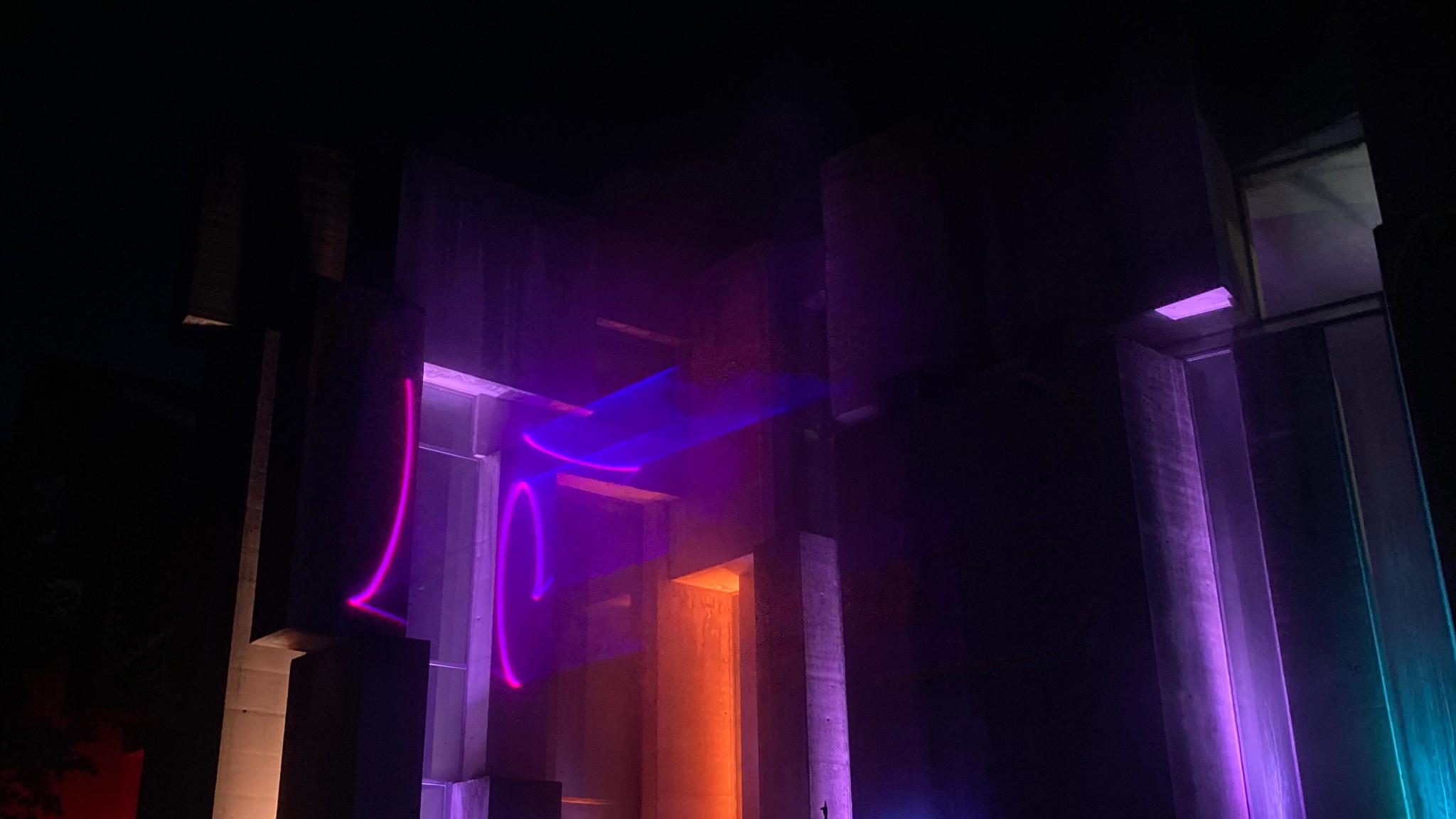
The main festival week started with the only dedicated discourse event: a talk with Timotheus Vermeulen, advocate of ‘metamodernity’, and Christian Egger, artist and publicist (stepping in for Christian Höller), moderated by Sophie Publig. Unfortunately, Vermeulen and Egger had little to say to each other, so we received half a metaphor-heavy lecture on philosophies of time and ‘metamodernity’ (if I understand correctly, Vermeulen means by this that today we live in an age in which we constantly invoke previous eras, in politics and art alike, which I personally don’t find to be a particularly useful or productive theory or concept - what does it allow us to think or perceive differently?) and half a report on Egger’s approach to time and temporality in his own practice (plus some very good live commentary on Vermeulen), with Publig piecing everything together as well as she could. This was followed up by a smooth, listening session-type DJ set by Martin Rovan, which seemed to make Vermeulen’s proposition audible through samples and sounds from across the decades. So the lecture at least made me experience the set a little more deeply. Next up was a performance by So Young Park, employing her own voice, with which she ‘sounded’ the Postsparkasse hall, exoskeleton structures, and striking body control. Although it didn’t wow me intensely, it was convincing without any outside explanation and kept up the tension throughout, both of which is where a lot of performances fail for me. The stand-out of the evening was Youmna Saba with her electrically extended oud and captivating voice. She produced a crazy range of sounds, reaching from disquieting drone noise to fulminant harmonies. Not understanding what she was singing, it was still clear that her songs demanded full attention.
9 Sept
I came a tad late for Isabella Forciniti’s set, which would become my highlight of the night. She played a live synthesizer set and created lively, stimulating, playful, satisfying soundscapes and beats, supported by her joyful stage presence. I can only recommend going to see her on her many live dates in Vienna. My suspiciousness towards Porgy&Bess was fuelled by older adult members of the audience bickering over apparently reserved seats? Don’t get me wrong, I am strongly in favour of back support, just not of the entitlement that came with it that night.
Piotr Kurek in quartet formation would have had a hard time catching me in any case, and I on the one hand can’t blame them because the delicate slowness of his compositions, while I can see their weirdness and beauty, was just too tough a task of presence for my mental state. I do feel disgruntled about what must have been their AI visuals animating the otherwise beautiful and fitting album artwork, making it extra hard to differentiate in my heart between the meandering aesthetic of the music and the wobbles of uhm, the five to six-fingered hands (not-so?-)gently caressing the planet earth on the screen.
The Necks… I hate to say it but they didn’t manage to catch either of the two of us the way we hoped. Personally I have seen them before and it was an absolutely beautifully psychedelic and ecstatic experience. Maybe their start-slow-and-meditative-and-get-more-and-more-intense-and-fast-over-time logic of playing their improvised gigs loses some magic when you already know what to expect, maybe it was the sound that wasn’t quite there, or just us, and expectations, but personally I was a bit let down.
10 Sept
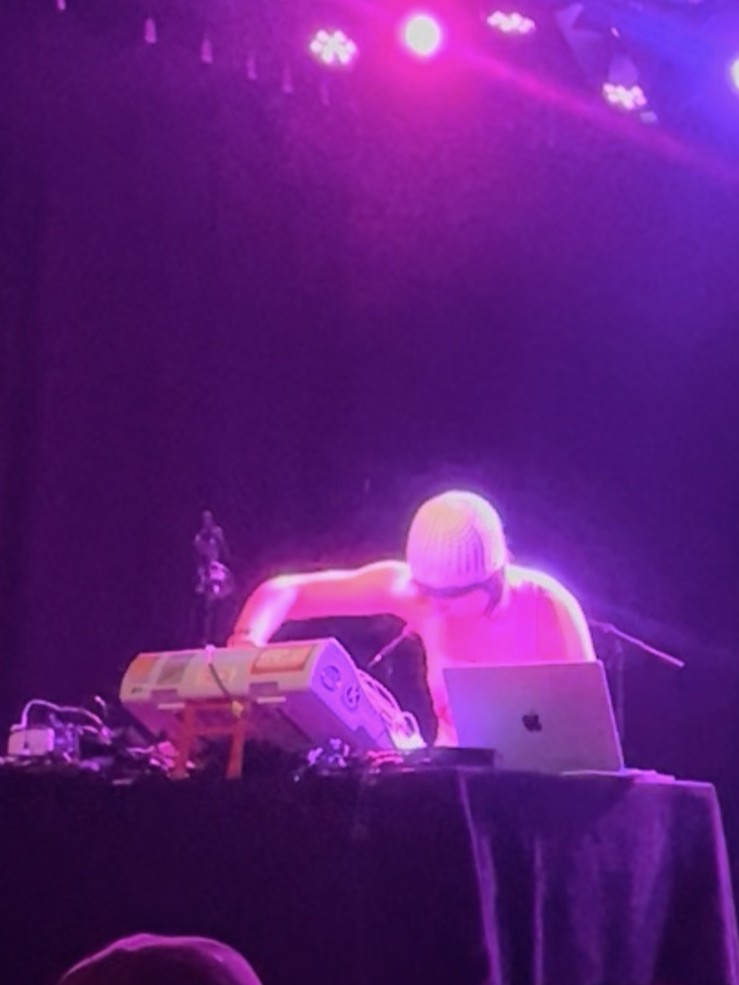
Arriving a bit late, I missed the beginning of Chloé Ryo’s concert which was comprised of two pieces. Ryo’s repertoire spans an eclectic mix of trombone sounds and techniques, experimental processing and immersive electronics. After the first piece she mentioned something along the lines of it making her feel nostalgic about a nature which she has never been to which really resonated with me and reminded me of Jon Hassell somehow. And thinking back on it, the concert (especially the first piece) had a very cool way of incorporating “Fourth World” sounds and effects.
Next up was Hampus Lindwall with a rather challenging organ performance. Admittedly, I found it a bit tough to get through since it was giving quirked up academic going crazy with his techniques. (Some of the Radiokulturhaus regulars seemingly were disgruntled by this lol…) Nonetheless, there were interesting moments for sure and the wall of sound towards the end did leave an impression.
After a short break, we entered the second phase of the evening with Claire M Singer laying down celestial organ drones. The pieces definitely encouraged a state of reflective deep listening for me. One could easily get lost in the resonant organ chords reverberating through the great sounding venue which felt like time was passing at a different pace.
Then I was excited to see Fennesz live for the first time and I really enjoyed it. His setup consisted of a guitar being run through electronics and computer processing which produced deep and nostalgic ambient soundscapes and textures. All of it had a distinctive Fennesz sound to which I thought translated quite well to the live setting.
In the final concert, Claire M Singer and Fennesz performed as a duo which I found quite special. Although it partially did feel like a superposition of the previous two concerts, the resulting performance gained new qualities and made for a particularly rich ambient soundscape. In particular, I thought that Singer’s organ playing elevated Fennesz’ digital soundscapes to a more lively and vibrant energy. In any case, it was immensely beautiful to listen to throughout and concluded the night on a high note.
11 Sept
Instantly when the night at WUK began, I had to note down NOW THIS IS MY HABITUS. With that admission of bias out of the way:
Bara & Isa played and sang their layered, deep, gentle, intimate songs facing each other, supported by a mixture of backing tracks and instruments including onion cutters and a harp, but their intertwining voices were leading the experience. Special mentions going to them covering a Fairuz song, and the two songs (including a gorgeous cover of Björk’s All Is Full Of Love) involving a choir dispersed throughout the audience.
Organ Tapes, after opening with a reggae cut?!, mostly played songs from his newer releases, which really grew on me in the month before. It’s beautiful and skilled songwriting, and he delivered it beautifully solo with his guitar and sometimes computer (and backed up by obscure handcam slice-of-life-and-nature visuals); however, an impression that had crept up to me while doing my pre-listening got much clearer: this is, dare I say, male-lone-wolf music. The themes of loneliness and isolation were expressed in a way that to me often came over as fundamentally depressing.
Ugnė Uma, no less alone, was an absolute standout and a testament to the power of just singing songs, no frills, when the songs and your presence with and through them are strong. Ugnė was standing on an equipment box as stage, no distractions, just a light on her, which could’ve been funny had she not been so majestic, singing over her (apparently smartphone-recorded) creaky piano backing instrumentals… it’s hard to say much more than go listen to this voice and know that she will absolutely command your attention live. Beauty and magic.
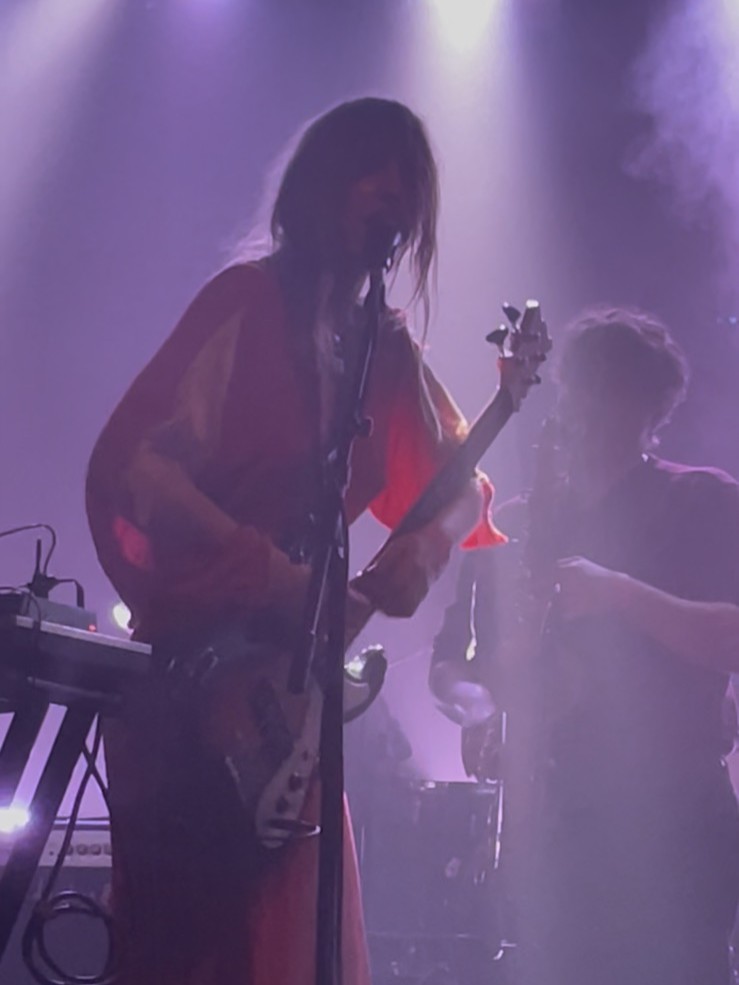
Friday night at Flucc, with simultaneous programme at Deck and Wanne was daringly varied. After a welcome set by Inou Ki Endo (Shilla Streika, the festival lead), we went downstairs for a literally spiritual performance by Masma Dream World. Unable to fully grasp what was happening, we can barely judge what we experienced, but it was certainly beautiful and intense. Taking a sharp left turn on the thus enchanted floor, Earth Ball psych-rock-jazz-noised it out to the max. Perhaps I was a little too set on a club type of experience, or maybe the contrast between Masma Dream World and this Canadian band was too strong for me, but I personally wasn’t super locked in (Impression from another freakazoid: I WAS!! yes the crowd was like 20 people but GOSH i love good noise rock <3). When we got back upstairs, there was only a little bit left of Lolina absolutely commanding the tightly packed Deck dancefloor with a rare type (at least for my experience of vienna) of unquestionably danceable lofi-y and groovy beats and tunes. Jess_whereyouat followed up with a groovy, funky, synth-forward set that was a good continuation of that energy. Later on, Azzi on the Beat was a crowd-pulling and extremely energetic and danceable highlight that showed us what afrofuturism can mean for the present. He clearly threw his all and not least his body into his set and everyone was in on it. Vienna needs more of this. মm. followed on with the kind of percussion-driven, adventurous set that we have come to love and expect (sorry) from them. I will always be there for their drumbreaks. Zey rounded everything out with a final, great-as-usual set for everyone who still had energy left (mine was used up well before the end) after a long and packed day and night.
12 Sept
I came too late for Yasmina Haddad’s DJ set (they are gorgeous usually) so started into the evening with Gintė Preisaitė, who was performing alone with her backing tracks and guitar. I was still pretty knocked out from the night programme so had to take this set as my (very fitting) sleepy slot, where my waning consciousness and Gintė’s soft voice was cushioned softly in gentle, droning, hard-to-place-what’s-playing soundscapes. My favourite moment was some song (listening back, I think it it was Deepen? where she repeated a phrase over and over again in a way that, uhm, deepened our shared presence.
I was a bit sad that she was performing alone, having heard how multi-layered her music was before, but (apart from the fact I have no idea if she even has a band) looking at the WUK programme of all three days, I suspect this also reflects the financial reality of organising this kind of festival, which, looking at Shilla’s Instagram stories, was already hard pressed to make it work in general.
The energy was then significantly changed by Amma Ateria, delivering a very intense audiovisual experience that was significantly enhanced by the Sounds Better With You soundsystem. I described it to a friend as ketamine music and kind of have to stand by that, but I mean it quite positively: It was existing in some very spacey middle ground between ambient and something much louder, with braintickling textures and grand, deep drones. Some of the sounds sounded like samples of running water, for others I just wrote down SPACE lol, and at least once I saw some (string?) instrument that I sadly failed to investigate further. The white-on-black particle physics visuals did make all of it into a “designed to be trippy” feeling experience but a) that’s not bad is it and b) it had a certain warmth and melancholy about it that elevated it into something with soul. (also there is more background on her website about this)
That warmth was pretty absent in Peter Kutin’s solo set, which was synth&strobes - nothing about it was creatively bad or boring but I personally couldn’t find way to make sense of the intensity and kind of neutral brutality of it. For another perspective, though, I saw someone on instagram describe the set as something like “the sound of birth-trauma in the best way”…
The evening was wrapped up by the absolute powerhouse that was Saint Abdullah and Eomac, in duo form, performing a set of live beats that felt much longer (in the best way) than the hour it occupied in clock time. I have to say that I felt pretty lost in the cultural references that must have been present in the samples used, but the relentless, dubby beats just blew me (and everyone as far as I could see) off my feet on their own and for better or worse made me forget about anything brainy. It was one of the moments in the festival where I most felt like Shilla’s self-description as being oriented towards global undergrounds (plural) really made sense, where any academic overtones vanished and the night made sense as simply a pretty wild mix of sick music and people who are there for all of it.
13 Sept
The music programme started with an ambient set by Brooklyn Pakathi that blended what I believe to have been field recordings, what I interpreted as traditional African songs and ambient music into a powerful soundscape that felt like it transported me into their personal world. Afterwards, Zara Joan Miller‘s performance alternated between reading poetry and beautiful synth melodies. The poetry was personal, intimate and at times funny. What really stood out to me was also the way that Miller read it, which was quiet and vulnerable, making it feel like she is letting the listeners in on a secret. I’m not entirely sure I understand how the synths connect to the poetry she read, but it certainly felt like a well-thought out performance.
Then Feeo performed, which was my personal highlight of the evening. She performed only with her guitarist and some synths and effect pads in dimmed light and subtle fog. Everyone was sitting or lying on the floor, which was the same level as the stage. She played mostly songs from her beautiful and vulnerable new album. Her performance was mesmerising in its simplicity, her voice is just captivating and the whole time barely any thought that wasn’t connected to this concert crossed my mind. Her music reminds me a lot of tirzah and early fka twigs because it’s so stripped back and focused on voice and because to me, it has the same immersive effect of being entirely in her heart wrenching but beautiful world. As cheesy as this sounds, it’s the kind of music that makes me feel human.
Playing after feeo is a hard feat, and to be honest, I might have enjoyed Richard Youngs‘s gig a bit more if he hadn’t had this time slot. I wasn’t in the right mood for a white guy playing psychedelic music on his guitar and singing in a way that I would call an acquired taste. I still think it was a good choice to book him because the music was really good and I‘m sure I would have been able to get into it if it hadn’t followed the grounding experience of the feeo concert. Still, I can definitely acknowledge his skillful playing and thoughtful songwriting.
The evening was accompanied by an exhibition featuring sculpture, video and installation. Even though the exhibition was mostly in the background of the concerts, I think it did complement the music very elegantly, and being able to roam through the exhibition in breaks or during the concerts was just really nice. In general, I think music and fine art should be connected a lot more and this was a very good example of how this could look.